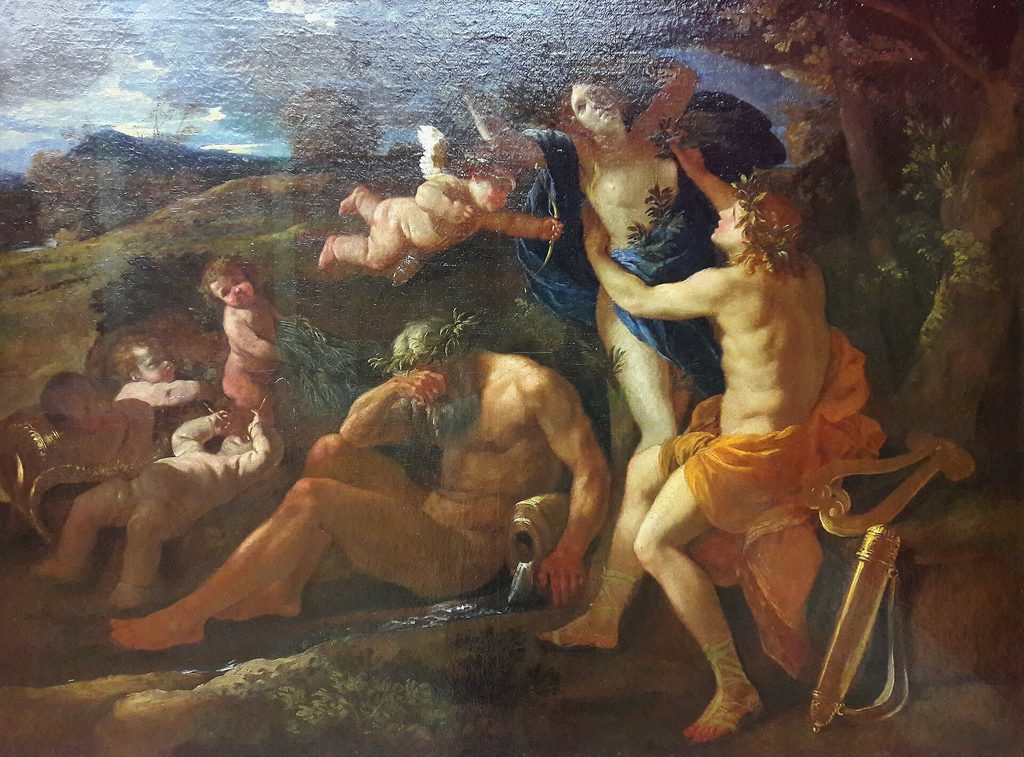
Apollo and Daphne
In brief
- Apollo mocked Eros for carrying a bow, and Eros answered with two arrows: one that made Apollo love, one that made Daphne refuse.
- She ran the length of the Vale of Tempe with the god gaining on her, and called on her father, the river Peneus, to destroy the beauty that had caused it.
- She became the laurel. Apollo took its leaves as his own, which is why victors were crowned with them.
Apollo had just killed Python, the serpent that lived at the foot of Parnassus, and he was pleased with himself. Seeing Eros bending a bow of his own, he told the smaller god to leave weapons to those who could use them. Eros said nothing and climbed to the top of Parnassus, where he took two arrows from his quiver. They were not the same. One was gold and sharp and made love; the other was lead and blunt and made love impossible. He shot the gold one into Apollo and the lead one into Daphne, daughter of the river Peneus.
Daphne wanted nothing to do with marriage. She had asked her father to let her stay unmarried, the way Artemis had, and he had agreed without quite understanding what he was agreeing to. Apollo saw her in the woods of the Vale of Tempe, and everything about her seemed to him like an argument for coming closer. He called after her. He explained who he was, which was the worst thing he could have done, because a god announcing himself to a woman running away from him has never once helped.
She ran. He followed, and Ovid says the chase went like a hound after a hare in an open field, the dog's muzzle at the animal's heels and the animal never quite caught, both of them running as if the distance between them were fixed. It was not fixed. He was a god and she was not, and the ground of the valley ran out at the river.
She called to her father in the water and asked him to change the shape that had brought this on her. The answer came while she was still speaking. Her feet took root, bark climbed her legs and closed over her, her arms went to branches and her hair to leaves, and what had been running a moment earlier stood still in the riverbank mud. Apollo put his hand against the trunk and felt her heart still moving under the new wood.
He could not have her, so he took the tree instead. The laurel would be his, he said: its leaves would crown generals in their triumphs and victors at his own games at Delphi, and because he was the god of eternal youth, its leaves would never fall. The branches, Ovid writes, moved as though the tree had nodded. He chose to read that as agreement.