Heracles and the Apples of the Hesperides
Heracles Stop 7 of 9

In brief
- Nobody knew where the garden was, so Heracles caught the shape-shifting sea god Nereus and held on through every form he took until he gave directions.
- On the way he freed Prometheus from his rock, and Prometheus told him not to pick the apples himself but to send Atlas.
- Atlas came back with them and offered to deliver them personally, meaning never to take the sky again, and Heracles got out of it with a request to adjust his shoulders.
The eleventh labour began with a problem of geography. The golden apples had been Gaia's wedding present to Hera, kept in a garden at the western edge of the world guarded by the Hesperides and by Ladon, a dragon with a hundred heads that never all slept, and nobody in Greece could say where the garden actually was.
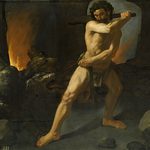
Heracles went looking for someone who would know. He found Nereus, the old man of the sea, asleep on a beach, and took hold of him. Nereus turned into water and into fire and into every animal in turn, and Heracles kept his grip through all of it until the god gave up and told him the way. Apollodorus notes the technique without comment, as though grabbing a deity and simply refusing to let go were standard practice.
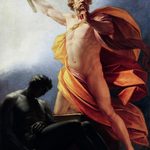
The road went past the Caucasus. Prometheus was still on his rock with the eagle at his liver, and Heracles shot the eagle and broke the chains, and Prometheus repaid him with advice worth more than the shooting: do not go into the garden yourself. Send Atlas, who is holding up the sky nearby and whose daughters the Hesperides are, and offer to take the weight while he goes.
Atlas agreed at once. He put the sky on Heracles's shoulders, walked into his daughters' garden, dealt with the dragon or talked past it depending on which version you read, and came back with three apples in his hand and the light of a man who has just realised something. He said he would take them to Eurystheus himself. Heracles could hold the sky in the meantime.
Heracles said that was reasonable, and asked only for a moment to fold a pad onto his head, because the weight was cutting into him. Atlas, obliging, took the sky back so the pad could be arranged. Heracles picked up the apples off the ground and left. Eurystheus, when they finally reached him, did not want them; nobody could keep them, so Athena took them back to the garden where they belonged.